Table of Contents
Age Restrictions
The Ceramics area is on the Warehouse side of DMS. Ceramics has sharp tools, many breakable items, and departments nearby with blow torches and heavy equipment.
- Members who are 16+ years old can use the space unsupervised.
- People 12+ years old must be directly supervised by their accompanying adult during the visit.
- Teachers can decide if they will teach under 16 or not at their discretion.
- DMS-wide age restrictions supersede committee rules.
The Shelving System
There are a few kinds of shelves, and each has specific requirements.
- In-Progress
- Greenware to be fired - items are fired to bisque
- Glaze to be fired
- Needs Attention
- Finished glaze and bisque work
In-Progress Shelves
- Bats/ware boards must be labeled with name/initials/mark and date when the piece was thrown/created.
- Use masking tape and the sharpie provided on the in-progress shelves to label your pieces.
- It’s safest to add 2 labels if the piece is covered (one on the bat/wareboard and one on the covering of your piece).
- Unlabeled pieces are considered abandoned and will be disposed of.
- Pieces can remain on bats for a maximum of one week before being moved onto ware boards.
- If you need to change the label, do not change the date. Use the same label and date as the original label’s date
- Labels must be transferred from bats to ware boards.
- Pieces on labeled ware boards will be disposed of 21 days after the labeled date.
- If your piece is not dry within the 21 days, you should take it home to dry.
- If your piece is large/odd/some special situation where this isn’t feasible please send a message on Talk to @Team_Ceramics
- Ware boards should be cleaned after you use them and put back in the correct space at our storage table.
Greenware to be Fired
Where you place greenware pieces that need to be fired or bisque re-fired.
- Ensure your pieces are completely dry before placing them on this shelf. This shelf is not for drying, but for immediate firing.
- Wet pieces (or pieces we suspect may be wet) will be placed on the Needs Attention shelf.
- Moisture in pieces may cause them to explode in the kiln damaging other members' pieces.
- Kiln team is not responsible if your piece blows up when fired.
Glazed Items to be Fired
Where you place glazed/re-glazed pieces that need to be fired/re-fired.
- Ensure your pieces are completely dry before placing them on this shelf. This shelf is not for drying, but for immediate firing.
- Anything out of the ordinary should have a note communicating what you are doing for the kiln team.
- If your piece is taking too long to dry and you need to go, use a heat gun to carefully dry the glaze. This may cause the glaze to dry with cracks or flake off, so use this sparingly.
- Wet pieces, or pieces we suspect may be wet, will be moved to the need’s attention shelf.
- You must follow the rules for glazing covered in the Orientation class, providing your own cookie if you have glaze lower than ¼ inch from the bottom of the piece.
- All posted or stilted items require you to provide your own cookie for firing.
Needs Attention Shelf
This is where you will find items the Kiln team feels might be questionable, or does not adhere to the firing shelf rules. This might be but not limited to:
- Glaze issues or questions from the Kiln Team
- The item is not bone dry, and is not ready for kiln firing
- Prohibited materials are in your piece, e.g. organic materials (leaves, grass, paper, etc.)
Shelf Use Time
All pieces on the 'In-Progress' Shelves much have label with creation/thrown date and some identifying mark of the maker.
As a community space, and we have to make sure there is room for everybody’s latest work, so we have strict shelf use rules.
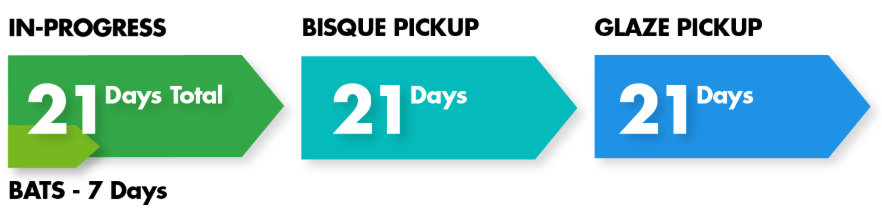
Pieces drying on DMS bats can only be on the shelf for 7 days, pieces on plastic bats for more than 7 days will be discarded.
In-progress pieces will be disposed of 21 days after the labeled creation/throwing date.
- Makers are responsible for their labeling and dating their work.
- Items without labels will be discarded on the next discard date.
- Pieces can remain on throwing bats for a maximum of 7 days.
- Discard dates/times are up to the discretion of the Shelf Cleaning Lead, and are not on the calendar.
- Disposal dates are not for a “last call”, they’re for disposal.
- Discarded pieces are not “up for grabs”, no matter how beautiful. They
Fired pieces also have a 21-day rule.
- The “timer” starts when that piece is removed from the kiln. Noted by a confetti token shape
- Abandoned bisque-fired pieces will be disposed of after 21 days on the pick-up shelf.
- Abandoned glaze-fired pieces will be disposed of after 21 days on the pick-up shelf
- Please place the little confetti star/balloon/etc..(call these things what you like) In the glass dish for reuse
In total, all pieces essentially have a generous 63 total days allowed to be on a shelf in the space (21 in progress, 21 bisque, and 21 fired), but it’s risky to wait until the last second to pick up your pieces, and it’s easy to forget your pieces are even there.
We recommend taking a photo of your pieces when you put them on a shelf as a “record” for yourself to check if you don’t remember what or how much you dropped off.
Maintaining and Cleaning the Space
The Ceramics space is a community, nobody “owns” it. Committee members volunteer to help maintain the space, but are not obligated to clean up after us. There’s no Ceramics cleaning staff, just trash disposal.
General
- Clean any space you use so that it’s clean for the next member.
- Members are responsible for cleaning the tools and machines they use, and putting things back in their proper place.
- A few times a year, the community comes together to clean the entire space. Day to day cleaning has to be done by the member who made the mess.
- All buckets, tools, and sponges are to be taken to the utility sink for cleaning, then put back where you got them.
- Throw lumps of clay in the trash can. The sink's clay trap is only meant to capture small amounts of clay and glaze, not clumps.
- Sweep or mop any trimmings, clay, slip splatters, or other messes.
- Use a damp sponge to clean any place you worked with clay, we should not be able to see the color of clay you used.
- If you find someone’s left a tool behind, it’s a kindness to post a photo on Talk and let them know you found it, and where it is now.
Slab Roller
- Clean up the slab roller after use by wiping the surface with a damp (not too wet) sponge to remove any dust, clumps, or smudges.
- Reset the height of the roller to 1 inch.
- Leave the canvases on the slab roller table, wet side open so they can dry.
- Use the side of the canvas marked DARK or LIGHT for rolling the color of clay you’re working with on both sides.
- Do not cut anything or use metal tools on the table’s canvas or rolling canvases. These can tear and snag the canvas.
- If the canvases get super dirty, post on Talk, or wash it yourself with a sponge and cold water only.
Slip Casting and Hump Molds
- Use only rubber or wooden tools on the edges of the slip casting molds.
- Tools should never touch the interior of a mold.
- Any mold (hump, slump, slip casting) can be occupied for no longer than 48 hours. If it is placed on in progress it should be on a ware board and labeled like any other work
Throwing Wheels
- All buckets, tools, and sponges are to be taken to the utility sink for cleaning, then put back where you got them.
- Throw lumps of clay in the trash can. The sink's clay trap is only meant to capture small amounts of clay and glaze, not clumps.
- Splash Pans are to be cleaned and stored on the back of the wheels not on the wire rack
- We should not know what color clay you used, if your wheel is clean. Always use a bucket with clean water to sponge the wheels
